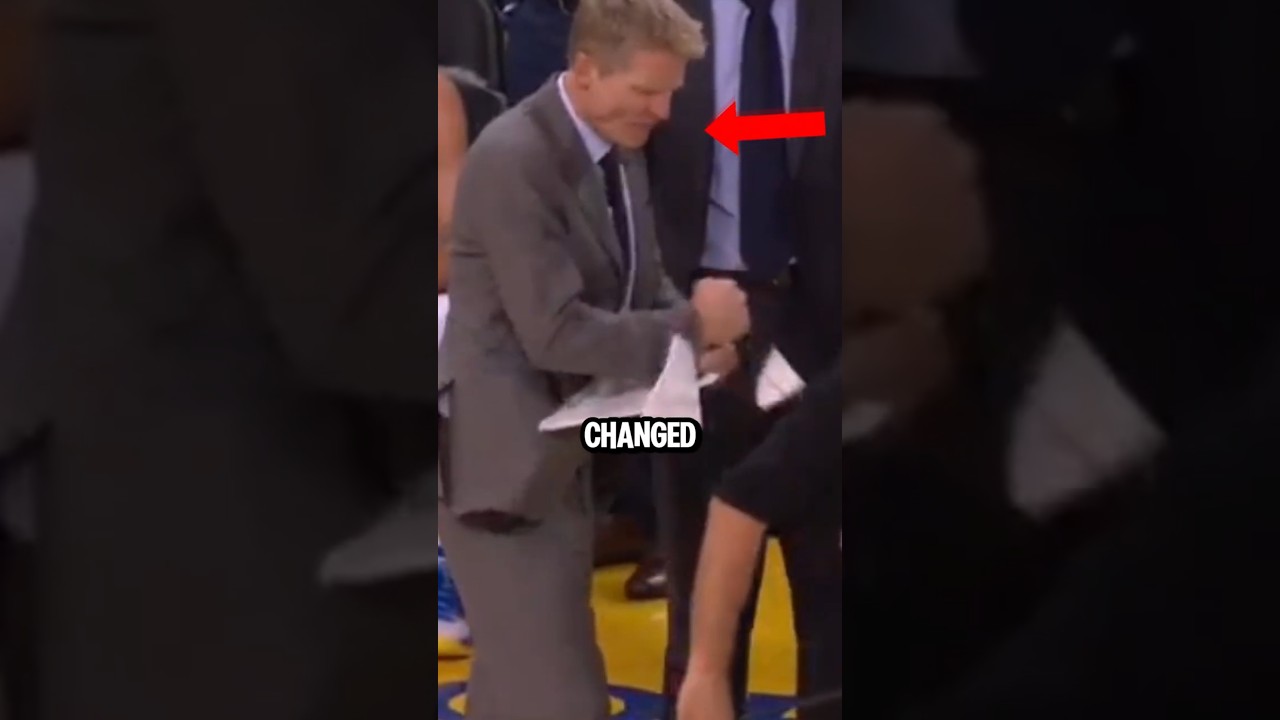
In May 2014, Steve Kerr was not yet a head coach. He had never even taken the job. What he had was two of the most influential men in basketball on the line at the same time, each trying to talk him into their version of the future.
On one side was Phil Jackson, freshly installed as New York Knicks president, pitching Kerr on a three-year, $13.2 million deal to run the Triangle offense and rebuild a franchise fresh off a 37-45 season. Jackson wanted a disciple — someone who had played in the Triangle, believed in it, and could sell it to a locker room being reshaped under his new front-office regime. Kerr, who had won three rings under Jackson in Chicago, was the obvious candidate. Their history made the conversation easy. The numbers did not.
On the other side was the Golden State Warriors, coming off a 51-31 season under Mark Jackson but convinced their young core — a then-emerging Stephen Curry, Klay Thompson and Draymond Green — needed a different coaching voice to reach the next tier. Warriors ownership had made the unpopular in-house call to move on from Mark Jackson. Joe Lacob's group was ready to put serious money behind the next guy.
The Knicks' offer, in hindsight, undersold what Kerr was actually being asked to do. He would be inheriting Phil Jackson's system implementation, Phil Jackson's timeline and, critically, Phil Jackson's shadow. The compensation, at roughly $4.4 million a year, was middling for a first-time NBA head coach even in 2014. Kerr's read was direct: the Knicks were not paying him like the franchise-anchoring hire they were describing.
The financial gap, more than the roster gap, moved the needle. Kerr felt undervalued in New York and tangibly valued in Oakland. When he signed with the Warriors, it was pitched in the moment as a coup for Golden State and a self-inflicted wound for Jackson's front-office project. The full reframing came in the 12 months that followed.
Kerr's first year as Warriors head coach rewrote the ceiling of the franchise. Golden State jumped from 51-31 to 67-15, swept through the 2015 postseason, and lifted the Larry O'Brien Trophy — the organisation's first title in 40 years. The Warriors didn't just get better. They changed how the league played.
The knock-on effects compounded. Golden State would reach five straight Finals starting in 2015, win four championships, cement Stephen Curry's status as the gravitational force of the modern NBA, and rewire offensive spacing and three-point priority for every other team in the league. The 2015-16 Warriors set the regular-season wins record at 73-9. The 2017 super-team, reinforced by Kevin Durant, produced one of the most efficient playoff runs in league history. None of it, in any honest accounting, happens without Kerr in the chair.
Meanwhile, the Knicks — the team that could not, or would not, close the gap on a first-time coach's contract — ran through Derek Fisher, Jeff Hornacek and Kurt Rambis on the sideline under Phil Jackson, struggled to implement the Triangle at NBA pace, and did not return to sustained playoff relevance for years. Jackson's presidency ended in 2017. The Triangle revival never arrived.
The lesson embedded in the story is not that Kerr was a generational coaching talent only one franchise recognised. Both franchises recognised him. The difference was that only one of them paid like they did.
A decade on, it is easy to treat the 2014 Kerr negotiation as a footnote — the preamble to a dynasty. But if the Knicks had matched, or if Kerr had valued the Jackson reunion more than the dollars, Curry's trajectory, the Warriors' ceiling and the league's stylistic re-engineering would all look very different. One phone call, one number that moved, and the NBA was reshaped.