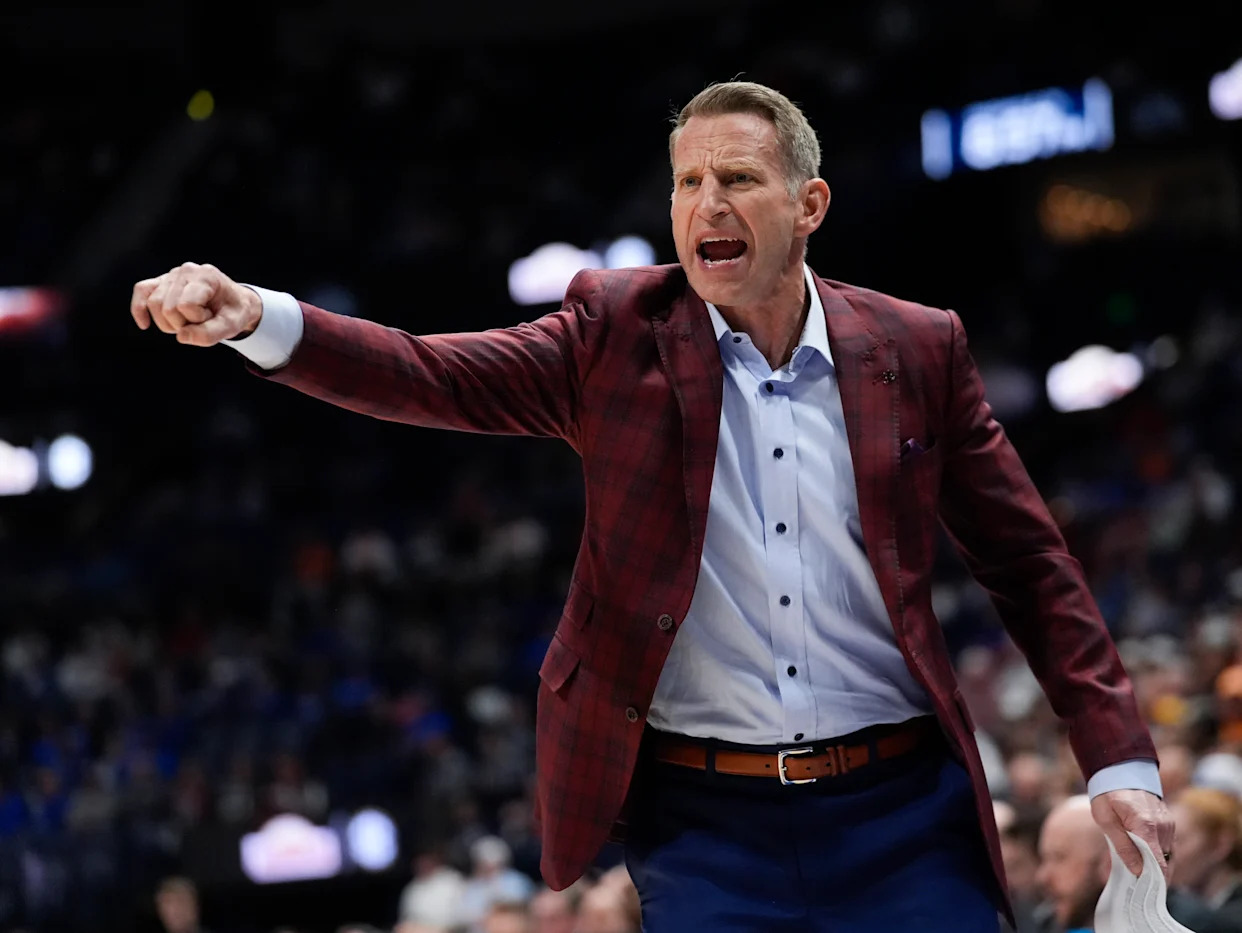
Nate Oats has built his Alabama program on what he calls blue-collar points: rebounds, deflections, loose balls, and the kind of effort that does not always show up next to a player's name in the box score. After a Sweet 16 exit to Michigan, the column he wanted to talk about was the one his team had lost.
"We lost the glass by 12 in the second half," Oats said. "We gave up five 0 boards the first three possessions. The second half we chart the blue collar stuff. The first media timeout, it was 30 to 1 on the blue collar points. The second half total was 61–32 them. They kind of just destroyed us on the effort plays."
Oats refused to flatten the night into a complaint about his own team. Michigan's size and physicality were the first thing he mentioned in his opening statement.
"First off, got to give Michigan a lot of credit," Oats said. "They — there's a reason they're a one seed. They're big, strong, athletic, physical. I thought our guys did a great job to be up two. We did a great job closing the first half, but the start of that second half wasn't quite where we needed to be."
Guard Latrell Wrightsell echoed his coach almost word for word, identifying the energy gap as the cause of the collapse.
"What went wrong was our energy and effort," Wrightsell said. "I think we started the game off with the utmost energy. We had an edge to us. So we were — Coach Oats talks about blue collar points, and that's just like all hard work things basically — tips, deflections, offensive rebounding. We just gave up too many in the second half."
For a senior class playing its last game, the press conference quickly turned into a wider tribute. Oats — known for an intense, almost unsentimental sideline persona — offered a description of his team that few had heard from him in his Alabama tenure.
"These guys that I coach have been one of the more enjoyable groups I've ever coached in my life," Oats said. "We had no locker room issues, none of that stuff like talking about attitudes. These guys did a great job controlling that."
Wrightsell expanded that feeling into an explicit faith argument. He said the team had built its identity not just on the practice court but in Bible studies and shared prayer.
"We embrace that a lot," Wrightsell said. "With the Bible studies, with getting closer to God, with praying before the games, with just our team bonding throughout the season from early on to now, it just grew all along. I think we grew a brotherhood that can't be broken."
Forward Houston Mallette built on the same theme, naming the principle the program quietly preached all year.
"Agape is God's love, his unconditional love for us as his children," Mallette said. "That's the example that I feel like we all in the locker room portrayed. We all love each other from the retreat. You could just see how connected this group was."
Mallette also returned to his backcourt mate Labaron Philon Jr., the freshman point guard whose tournament breakout has reframed Alabama's roster outlook for the next two seasons.
"I think he's the best guard in the country, by far and away in my opinion," Mallette said. "What he's been able to do — I love him. He's amazing."
Oats said the off-season would now begin with a hard look at the roster's physical profile. Michigan's frontcourt had simply been bigger and longer than what Alabama could counter, and the Tide would need to address that imbalance.
"We know we got to change a little bit," Oats said. "Some of the adversity was, you know, Caton Bristow with the injuries. When we played up here the first time against Illinois, he kind of might have been the MVP of the game."
For a coach famous for treating his bench like a high-energy startup, the postgame was unusually reflective. Oats had built a Sweet 16 team out of a roster he openly admitted needed to get bigger, had watched it lose the same way bigger teams have always beaten his — on the glass — and had then chosen to use his press conference to talk about love, faith, and a brotherhood that he said, win or lose, did not break.