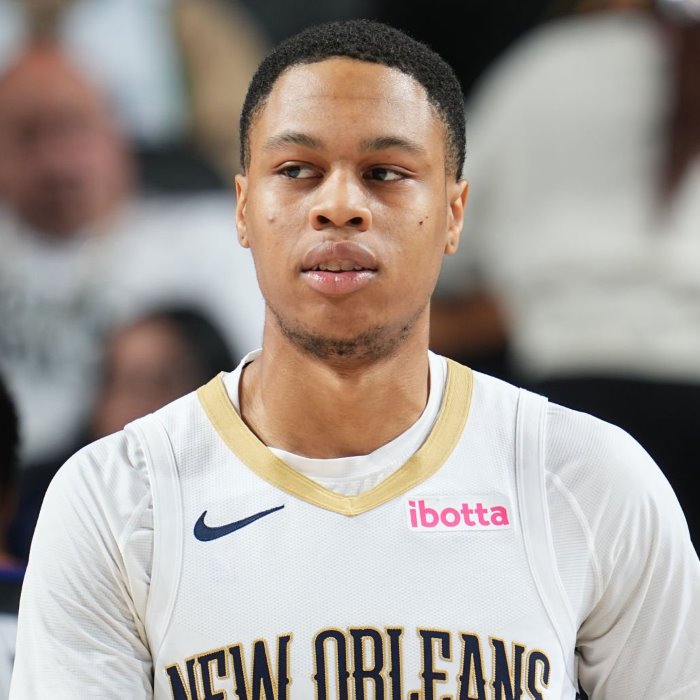
Jordan Hawkins stands at a crossroads that many young NBA players know well – the delicate balance between potential and production, between draft expectations and professional reality. The 6-foot-5 shooting guard from Gaithersburg, Maryland, has been working to carve out his niche in the New Orleans Pelicans' rotation, bringing the skill set that made him a coveted prospect to the demanding stage of professional basketball.
Wearing number 24 for the Pelicans, Hawkins represents the type of versatile wing player that has become increasingly valuable in today's NBA. His 190-pound frame reflects the modern shooting guard prototype – athletic enough to defend multiple positions while maintaining the agility needed to create separation on offense. At 1.96 meters tall, he possesses the length to contest shots and disrupt passing lanes, attributes that have caught the attention of the Pelicans' coaching staff as they continue to develop their young core.
The Maryland native's journey to New Orleans reflects the increasingly complex path many players take to reach the NBA. His background suggests a player who has had to earn every opportunity, developing his game through dedication rather than relying solely on natural gifts. This work ethic has become a defining characteristic as he adapts to the speed and physicality of professional basketball.

In the Pelicans' system, Hawkins has been tasked with providing depth in the backcourt while demonstrating the shooting ability that teams covet in today's three-point heavy league. His role has evolved as the season has progressed, with coaches looking to maximize his strengths while helping him address the areas of his game that need refinement. The shooting guard position demands versatility – the ability to play both on and off the ball, to create offense while also functioning as a complementary piece alongside established stars.
Championship Implications
Hawkins' physical dimensions make him an intriguing prospect for a Pelicans team that has been building around young talent while trying to maximize their championship window. His height gives him an advantage over smaller guards while his weight suggests the speed and quickness needed to stay competitive against the league's elite perimeter players. These physical tools provide the foundation, but his development will ultimately depend on how quickly he can adapt to the mental and tactical demands of NBA basketball.

**Related:** [Brandon Boston Jr. Finding His Footing with New Orleans Pelicans After Challenging NBA Journey](/article/brandon-boston-jr-finding-his-footing-with-new-orleans-pelicans-after-challengin-0a3ff4)
The modern NBA shooting guard must be multifaceted, and Hawkins appears to possess several key attributes that suggest long-term potential. His size allows him to see over defenses and make passes that smaller guards cannot, while also giving him the ability to post up when matched against shorter opponents. Defensively, his length enables him to guard both backcourt positions effectively, a flexibility that has become essential in an era of position-less basketball.
Looking Ahead
For the Pelicans, Hawkins represents both present opportunity and future investment. The organization has shown a commitment to developing young talent, and his progression could prove crucial to their long-term success. His ability to contribute meaningful minutes while continuing to develop his game makes him a valuable asset in a league where depth and versatility often determine playoff success.
The challenges facing Hawkins are typical of those confronting young guards in the NBA. The speed of decision-making required at the professional level often represents the steepest learning curve, as players must quickly identify defensive schemes and react accordingly. His shooting consistency will be closely monitored, as three-point accuracy often determines how much playing time young guards receive in today's analytics-driven league.
Career Journey
Hawkins' background from Gaithersburg places him among a growing number of Maryland products making their mark in professional basketball. The region has produced numerous NBA talents, and his success could inspire future generations of players from the area. His journey also reflects the diverse pathways that lead to the NBA, demonstrating that talent can emerge from various backgrounds and development systems.
As the season progresses, Hawkins' development will be measured not just in traditional statistics but in his overall basketball IQ and decision-making. The Pelicans' coaching staff will be looking for consistent improvement in his pick-and-roll recognition, his ability to move without the ball, and his defensive positioning. These fundamental skills often separate players who have long NBA careers from those who struggle to find consistent playing time.
The number 24 that Hawkins wears carries no particular historical significance for the franchise, but it represents his opportunity to create his own legacy in New Orleans. For a young player trying to establish himself in one of the world's most competitive basketball leagues, every game represents a chance to prove his worth and solidify his place in the rotation.
Looking ahead, Hawkins' trajectory will depend largely on his ability to maximize his physical gifts while developing the mental aspects of his game. The Pelicans have invested in his potential, and his continued development could prove crucial to their aspirations of sustained success in an increasingly competitive Western Conference.
