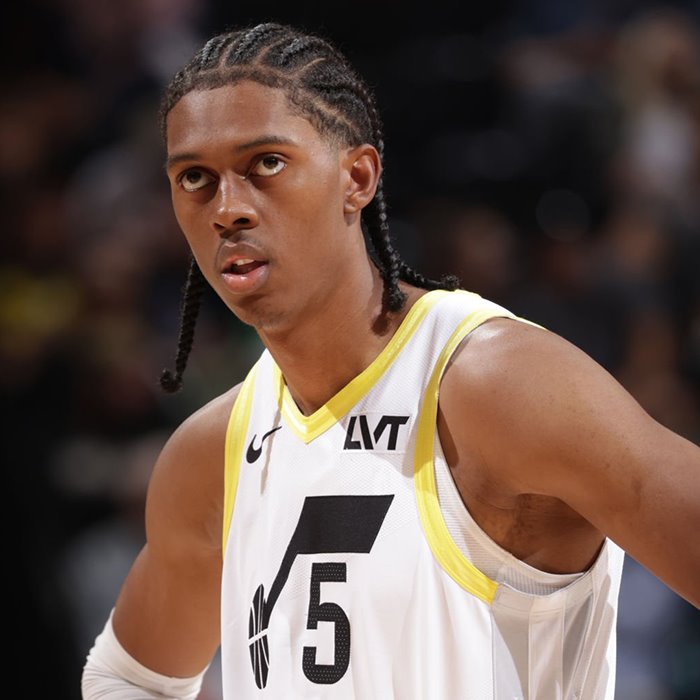
At 6-foot-8 and wearing number 5 for the Utah Jazz, Cody Williams represents the future of basketball in Salt Lake City. The small forward from San Luis Obispo, California, has been steadily adapting to the rigors of NBA basketball as part of Utah's youth movement and rebuilding effort.
Williams brings an intriguing blend of size and athleticism to the Jazz roster. Standing tall at 6'8" with a lean 190-pound frame, he possesses the physical tools that modern NBA teams covet in their wing players. His height gives him versatility on both ends of the floor, allowing him to defend multiple positions while providing matchup problems for opposing teams.
The California native's journey to the NBA has been marked by steady development and an understanding of what it takes to compete at basketball's highest level. His slender build, while sometimes viewed as a potential weakness in the physical NBA environment, also provides him with the mobility and quickness that can be advantages in today's pace-and-space league.

For the Jazz, Williams represents a key piece in their long-term vision. Utah has been in a transitional phase, moving away from their veteran-laden teams of recent years toward a younger core built for sustained success. Williams fits perfectly into this timeline, offering the organization a player who can grow alongside other young talents in the system.
His role with the Jazz has been evolving throughout the season as coaching staff members assess his strengths and areas for improvement. At the small forward position, Williams is expected to contribute in multiple facets of the game. His height advantage allows him to be effective in rebounding situations, while his wing skills make him a potential threat in transition and half-court offensive sets.
**Related:** [Zac Lomax Switches Codes: NRL Star Signs Two-Year Deal With Western Force](/article/zac-lomax-switches-codes-nrl-star-signs-two-year-deal-with-western-force)

Defensively, Williams' length is perhaps his most valuable asset. In an NBA where perimeter shooting and ball movement are paramount, having a 6'8" defender who can contest shots and disrupt passing lanes is invaluable. The Jazz have been working with Williams to maximize this natural advantage, teaching him to use his wingspan effectively while maintaining proper positioning.
Offensively, the development process continues for the young forward. His size creates natural advantages in certain matchups, particularly against smaller guards who might be switched onto him in defensive schemes. The Jazz coaching staff has been focusing on helping Williams understand how to exploit these mismatches consistently.

The transition from amateur basketball to the NBA is never seamless, and Williams' experience has been no different. The speed of the game, the physicality of opponents, and the mental demands of an 82-game season all present challenges that every rookie must navigate. For Williams, adding strength to his 190-pound frame has been an ongoing priority, as NBA-level physicality requires players to hold their ground against much stronger opponents.

Williams' development timeline aligns well with Utah's organizational philosophy. The Jazz have shown patience with young players in recent years, understanding that sustainable success often comes from allowing talented individuals to grow into their roles rather than rushing them into situations where they might struggle.
Race Results
The small forward position in today's NBA demands versatility, and Williams is working to develop the complete skill set required to thrive. This includes improving his three-point shooting consistency, enhancing his ball-handling abilities, and continuing to add the strength necessary to finish through contact at the rim.
Utah's coaching staff has praised Williams' work ethic and coachability throughout his rookie campaign. His willingness to learn and adapt has been evident in practices and games, as he continues to absorb the nuances of NBA-level basketball. The organization views this attitude as equally important as his physical tools.
Career Journey
Looking ahead, Williams' ceiling appears promising given his combination of size, athleticism, and basketball IQ. The Jazz are building something special in Salt Lake City, and players like Williams are central to those plans. His development over the coming seasons will be crucial not only for his individual career trajectory but also for Utah's hopes of returning to playoff contention.
Impact and Legacy
The California native has shown flashes of the potential that made him attractive to NBA scouts. His ability to impact games in multiple ways – whether through defensive stops, timely rebounds, or offensive contributions – suggests a player who could develop into a reliable rotation piece and potentially more.
As the season progresses, Williams continues to adapt to the NBA lifestyle and competition level. Each game presents new learning opportunities, and his approach to these challenges will largely determine how quickly he can become a consistent contributor for the Jazz.
For Utah fans, Williams represents hope for the future. In a league where young talent often takes time to develop, patience will be key as this promising forward works to establish himself as a dependable NBA player. His journey from San Luis Obispo to Salt Lake City is just beginning, and the basketball world will be watching to see how this story unfolds.