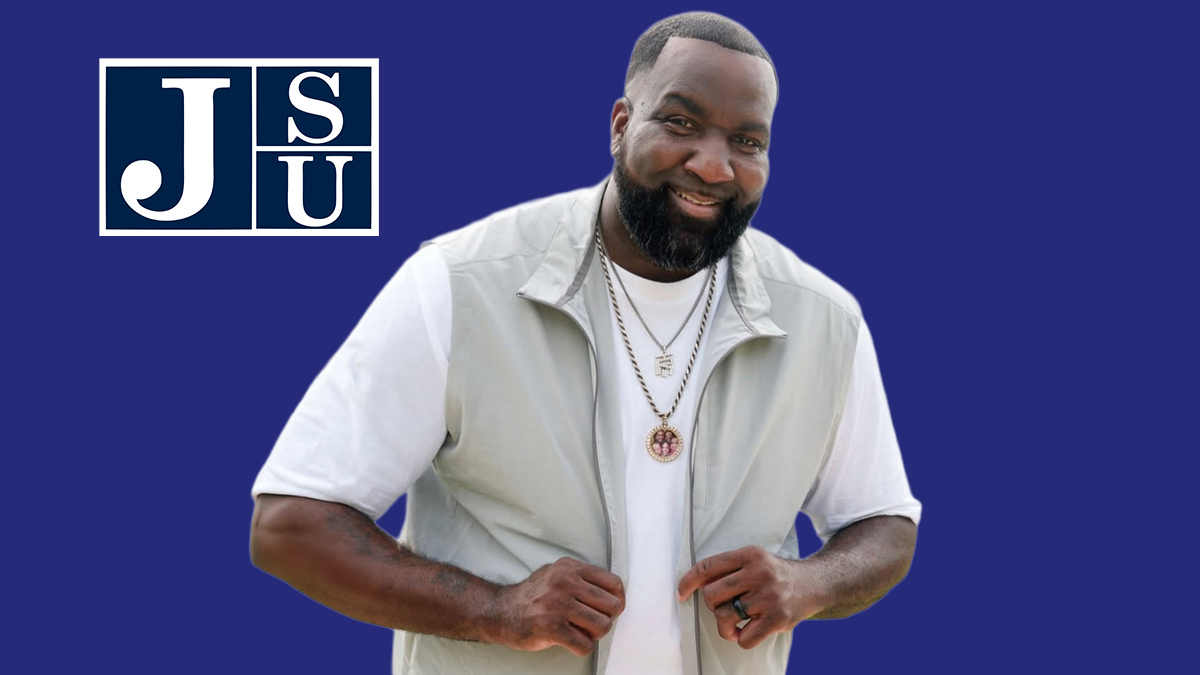
Kendrick Perkins is adding a front-office title to his resume without leaving the broadcast desk. The 14-year NBA veteran and ESPN analyst has agreed to become the men's basketball general manager at Jackson State, the latest sign of how former players are reshaping the college game off the court.
The move was first reported by ESPN's Shams Charania on Friday. Perkins will keep his on-air role at ESPN while taking on the GM job at the Mississippi HBCU, and the position also ties him to the university's broadcast and journalism program.
"I'm thankful for this opportunity to impact young lives and pour back into my community," Perkins told Charania.
Perkins worked closely with new Jackson State head coach Trey Johnson and vice president and director of athletics Ashley Robinson to finalize the role. Johnson, a former Jackson State standout, was recently elevated to lead the program. The pairing gives the Tigers a recognizable name in the front office and a head coach with deep ties to the school.
The hire fits a broader trend. A growing number of former NBA players have stepped into front-office-style roles in college basketball, lending star power and professional credibility to recruiting and roster construction in the transfer-portal era. HBCU Gameday noted that Jackson State has already seen what a marquee name can do for a program: Deion Sanders' football tenure brought national attention to the campus, and the school is betting Perkins can spark similar momentum on the hardwood.
Perkins' own playing path makes the appointment notable. He entered the NBA straight out of high school after being named a McDonald's All-American in Beaumont, Texas, and never played college basketball himself. He was selected 27th overall by the Memphis Grizzlies in the 2003 draft and immediately traded to Boston, where he became a starter on the 2008 championship team alongside Kevin Garnett and Paul Pierce. Over 14 seasons he averaged 5.4 points and 5.8 rebounds before retiring in 2018.
Since then, Perkins has become one of ESPN's most visible NBA voices, a fixture on debate programming known for blunt takes. Now 41, he steps into a job that asks him to build something rather than analyze it — and to do so at a program looking to make its own splash.
Whether the dual role proves sustainable will be one of the early storylines. Perkins is not stepping away from television, which means he will be evaluating the NBA on air while assembling a college roster at the same time. For Jackson State, the calculation is simpler: a nationally known champion now has his name attached to the program, and that alone changes the conversation.