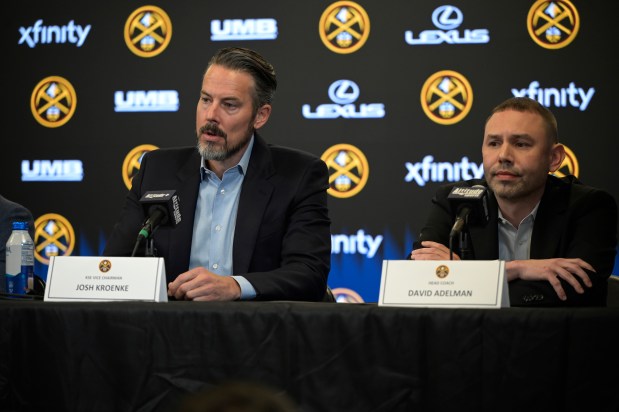
The Denver Nuggets gathered in front of the cameras on Friday for an end-of-season press conference that did not have the look of a franchise about to blow itself up, despite a second-round playoff exit to the Minnesota Timberwolves. Sitting alongside head coach David Adelman, basketball operations leaders John Tenzer and Ben Wallace, and ownership at his shoulder, governor Josh Kroenke spoke for almost an hour and used his most forceful language to draw two lines: Adelman is staying, and Nikola Jokic is not being traded.
Kroenke addressed a recent run of national reports speculating that the Nuggets might at least listen on Jokic and that fans had booed Adelman's hiring before a home playoff game. He pushed back on both, hard.
"I have full faith in Coach Adelman," Kroenke said. "I think he coached a hell of a season all things considered. I think anybody saying something like that is speaking from a place of emotion. And I would say that my job in this organization is to help make decisions without emotion."
On Jokic, Kroenke went a step further than the standard ownership boilerplate.
"I think we need to have running it back as a possibility," Kroenke said. "Everything's on the table right now, including running it back. I should be clear, because my words got twisted in an interesting way last summer — but yeah, I think everything's on the table outside of trading Nikola."
That firm denial came alongside a remarkably candid reading of the season just gone. Kroenke called the year a frustrating one and said he was not going to mask the disappointment of how it ended. Adelman, when his turn came, framed the entire campaign as one in which the team never got to be itself.
"This season was in a lot of ways the season that never was," Adelman said. "This group never fully got a chance to show any kind of rhythm, when you're going to have the amount of turnover and change that we did last year. Basketball is a rhythm game and the team as a whole never had a chance to fully establish a rhythm, and that truly showed up when the games mattered in April."
Adelman pointed to Jokic's mid-season injury as the structural fault line of the year. The two-time MVP returned, the coach said, but a part of his shooting touch did not.
"A microcosm of our season is almost Nikola before and after the injury," Adelman said. "He was one player before, and when you came back he was still incredible in so many facets, but for some reason his three-point shot left him."
Kroenke also addressed the financial backdrop that has shadowed Denver's roster decisions: the second apron, the luxury tax, and the willingness to spend around Jokic's prime. Last summer's trade of Michael Porter Jr. broke up the championship core, Kroenke said, and was a deliberate flexibility move rather than a cost-cutting one. He insisted the team's deadline inactivity was not a tax-avoidance signal but a refusal to give up assets without a clear basketball case.
"My job as an organization is to look at everything," Kroenke said. "I don't think we made ourselves any worse with what we did at the deadline. If our team was healthy for the entire season, we wouldn't have needed to do anything at the deadline. So I have to be responsible in all angles, and to me that was more of a move to preserve flexibility than anything."
On Aaron Gordon, the connective forward whose health repeatedly defined Denver's ceiling, Kroenke offered a cooler answer than fans booing his name might have expected.
"I love Aaron Gordon. I think the world of him, just like the entire Nuggets Nation does. But there are some things that we're going to have to look at. This team looks a lot different when Aaron Gordon's healthy. So we need a healthy Aaron Gordon, and we need to figure out how to make the most of him and get the most out of his body for the benefit of the team."
Kroenke confirmed the offseason process would be a collective one across him, Tenzer and Wallace, with a wider front-office strategic group involved in any major decision. Asked directly whether he was the de facto general manager, he was unequivocal that he was not.
"I'm the president of the team. I've been in the same role since 2010. Whether that was Masai Ujiri, whether that was Tim Connelly, whether that was Calvin Booth, whether that's these guys — I'm always going to be there listening and trying to help shape the direction of the franchise."
For Nuggets fans waiting for a verdict on the future, the most consequential takeaway was the simplest: Adelman has the chair, Jokic is not for sale, and continuity is back on the menu — but not at the cost of accountability.