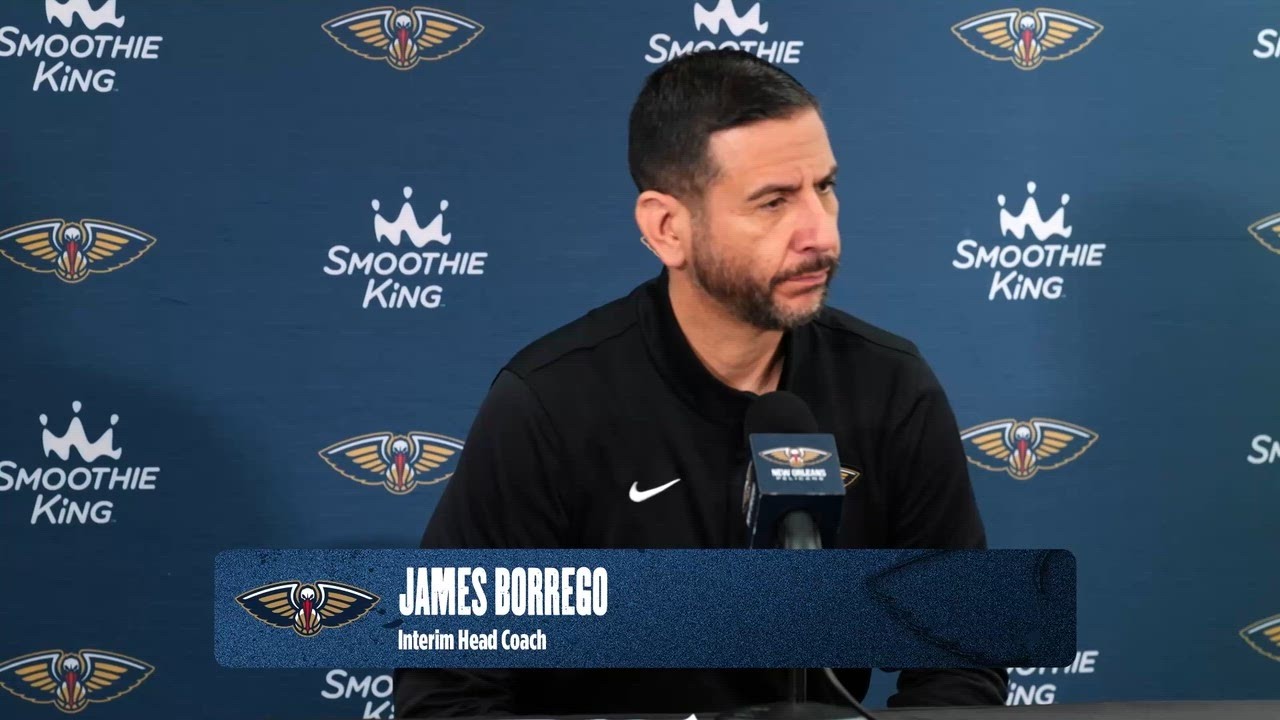
New Orleans Pelicans head coach James Borrego spent a meaningful share of his postgame media availability discussing the team's rookie bench unit — a group he had pointedly challenged just days earlier — and the message afterwards was closer to genuine pride than a coach trying to project it.
The Pelicans lost the game itself on the back of a familiar mix of ball-security and second-chance-points problems. Borrego was clear about where the damage came from.
"A little bit of both. You know, they had pressure in the first half, you know, and just poor decisions, sloppy play, poor third quarter, you know, we just turned it over too much. Second chance points. I think they finished with 50 points off turnovers and second chance points combined," Borrego said.

But within that loss, Borrego identified a development story worth protecting.
"Yeah, I think we had the three rookies out there. There was a great lineup with them, you know. Uh Fears was great. Queen, that's probably some of the best basketball I've seen them play together. Um, so really proud of that group for responding, you know," Borrego said.
The response line was deliberate. Earlier in the week, Borrego had spoken bluntly about his rookies' energy level in a previous outing, and public criticism from a coach to a rookie group is often a direction-setting moment in a young player's development cycle. By naming the players and putting the line on the record, Borrego closed the loop.
His praise for guard Jeremiah Fears went further, framing the season as a build rather than a series of flashes.
"That's a good sign. And you know, I think there's he's putting a great case together, you know, and uh and that's what development and growth's about. Like he's just stacking high quality games together. He's impacting winning. Um his effort defensively is there," Borrego said.
For a Pelicans franchise that has been defined in recent seasons by injuries to high-profile stars, the early returns on the rookie class represent something close to an insurance policy against whichever direction the roster pivots in the off-season.
Fears was the younger piece of New Orleans' 2025 draft haul, a combo guard taken with the expectation that his feel and scoring touch would need a season to mature into NBA-level impact. What Borrego is describing — effort defensively, impact on winning plays, stacking games — is the exact profile the front office bet on.
Queen, the frontcourt pickup, has had a more uneven season statistically but has generated better team outcomes when on the floor alongside the Pelicans' rookie guards than the box score suggests.
Borrego's willingness to praise a losing-game lineup publicly, on the record, is itself a coaching choice. It signals to the rest of the roster that young players' minutes will be protected on merit, and it tells the rookies directly that response is noticed even when the scoreboard does not co-operate.
In a season where New Orleans is not chasing a title but is shaping the core of its next one, that kind of coaching public-relations is not trivial. It is the development curriculum.